Smarter Ventilation: How Better HVAC Design Elevates Any Kitchen
As commercial kitchens continue to evolve—with faster service models, smaller footprints, and increasing energy demands—your HVAC and hood design plays a critical role in ensuring safe, efficient, and comfortable foodservice operations.
At Boelter, we’ve seen firsthand how smart kitchen ventilation strategies can solve complex challenges and create healthier work environments. Whether you're building from the ground up or renovating an existing space, our foodservice design team helps you make sense of the many options and requirements for hood design, exhaust, and make-up air (MUA).
Here are the key factors, and best practices, we consider when designing kitchen ventilation systems that deliver lasting results.
Why Smart HVAC Design Matters
An effective hood and HVAC system does more than capture grease and smoke—it supports energy efficiency, worker safety, food quality, and code compliance. Done poorly, it can lead to poor air quality, comfort complaints, excessive utility bills, and even fire safety issues.
Our approach starts with understanding your operation and footprint. Are you using gas or electric equipment? How is your building constructed? What is your roof clearance? We consider everything from duct layout to equipment weight to design a system that works with your structure, not against it.
Best Practices for Hood Design
From small cafes to large-scale institutional kitchens, here are core design principles we recommend:
- Right-Sized Coverage: Hoods should extend 12" beyond the front of the cooking line and 10-12” on the sides, depending on wall locations and equipment types.
- End Panels Improve Performance: Use ¼, ½, ¾ or full end panels to boost capture efficiency, especially in tight spaces.
- Weight Matters: Not all roofs can support heavy rooftop units. We explore alternatives like side discharge fans and on-grade MUA units.
- Don’t Forget the Details: Sprinkler systems, duct clearances, and ceiling heights all influence design and installation options.
- Grease Applications: Hoods must be UL -710 rated and include a fire protection system that meets UL-300 and NFPA-96 standards.
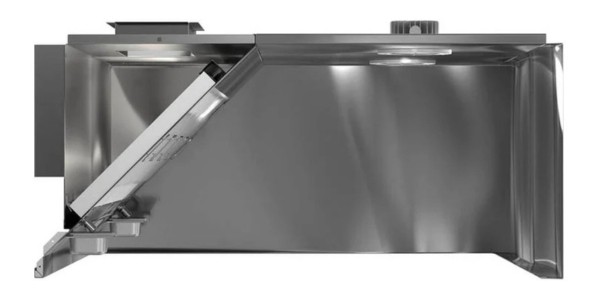
- Type II Condensate Hood: Constructed entirely of 304 stainless steel construction, these are designed for non-grease producing equipment.
Choosing the Right Hood and Control Package
Standard Hood Options
Ideal for kitchens where the building HVAC system provides 100% of the make-up air. Common hood styles include:
- Wall Canopy (standard wall-mounted)
- Sloped Front Wall Canopy (slim, limited-clearance)
- Backshelf Hoods (low proximity)
- Single and Dual (island canopy)
- Heat and Condensate (Type II)
Grease Filter Options
- Baffle Filter – Removes 30-40% of the grease from the air steam; recommended for light cooking applications.
- Grease-X-Tractor Filter – Removes up to 69% of the grease particles at 8 microns; suitable for light and medium-duty cooking. UL-1046 spark arrestor-approved for use over solid fuel cooking applications.
- Grease Grabber / Dual Stage Filter – Removes 100% of the grease particles at 5 microns; ideal for heavy grease applications.
Controls: Play a big part in air control and energy efficiency. There are two options in hood controls. Constant Volume (fig. 1) is where the hood starts and keeps the same exhaust rate 100% of the time. Variable Volume or DCV (Demand Control Ventilation) (fig. 2) is where the hood adjusts the exhaust rate based on the amount of heat and/or smoke created by the cooking process.
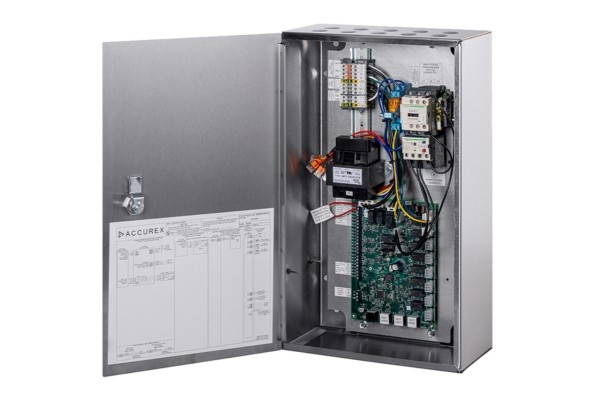
fig. 1
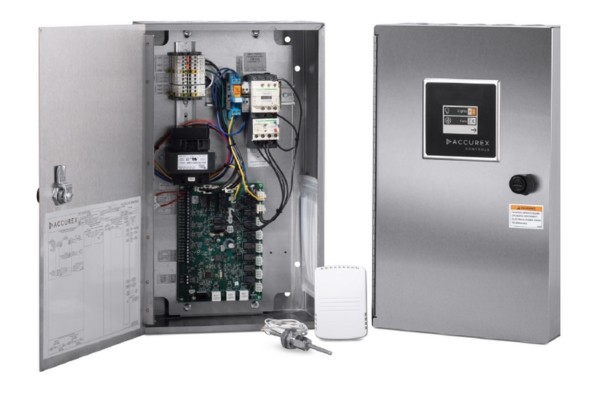
fig. 2
Option 1: Heated Only Make-Up Air at Hood
Adds a heated air plenum, either with Perforated Supply Plenum or through ceiling diffusers the MUA unit can provide up 100% supply air.
- Enhances capture and comfort in colder climates.
- Provided in Direct fired and Indirect fired units.
- Control: Can be either Constant Volume or DCV.
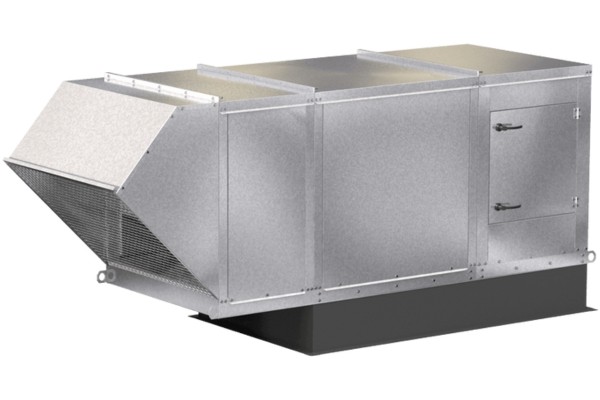
Option 2: Heated + Cooled Make-Up Air at Hood
Same design as Option 1 but adds AC/DX (Air Conditioning with Direct Expansion cooling) and DOAS units to provide both tempered air with humidity control to the plenum system for around 70% supply air. The system does have load limits and is best used in low to medium-sized kitchens.
- Better supports kitchens in warmer climates and areas that see higher humidity.
- Control: Can be either Constant Volume or DCV. Turn down rate depends on the area and system loads.
- Unit is only offered in direct fired units.
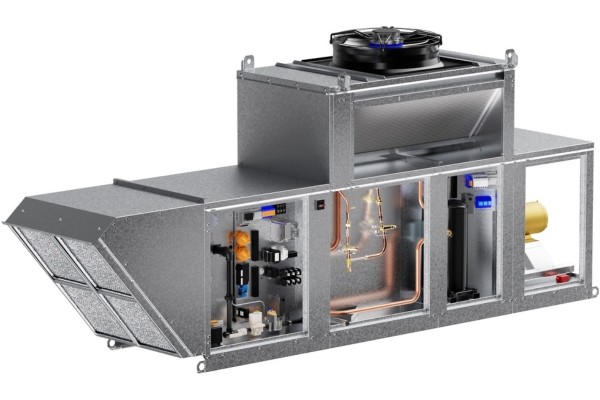
Option 3: 100% Heated & Cooled Air at Hood
The most robust option, distributing 80%-100% supply air with 70-80% of the air conditioned at the hood and 20% outside via diffusers. DOAS / XRV systems provide the best performance and energy efficiency along with dehumidifying the air.
- Ideal for high-volume or high-heat kitchens where worker comfort is critical.
- Includes advanced DCV options with building system integration.
Partnering for Smarter Ventilation
No two kitchens are alike. That’s why our design team works closely with architects, engineers, and operators to get it right from the start. We leverage BIM modeling, CAD layouts, and jobsite experience to ensure smooth coordination and fewer surprises during install.
Whether you need a full kitchen exhaust solution or are just exploring HVAC options for renovation, Boelter can help. Smart ventilation starts with smart planning—and we’re here to guide you every step of the way.
Reach out to our design team to discuss your foodservice project and how smart hood design can help you operate better, safer, and more efficiently.